What Should a Digital Marketing Course Actually Include?
Aug 10, 2026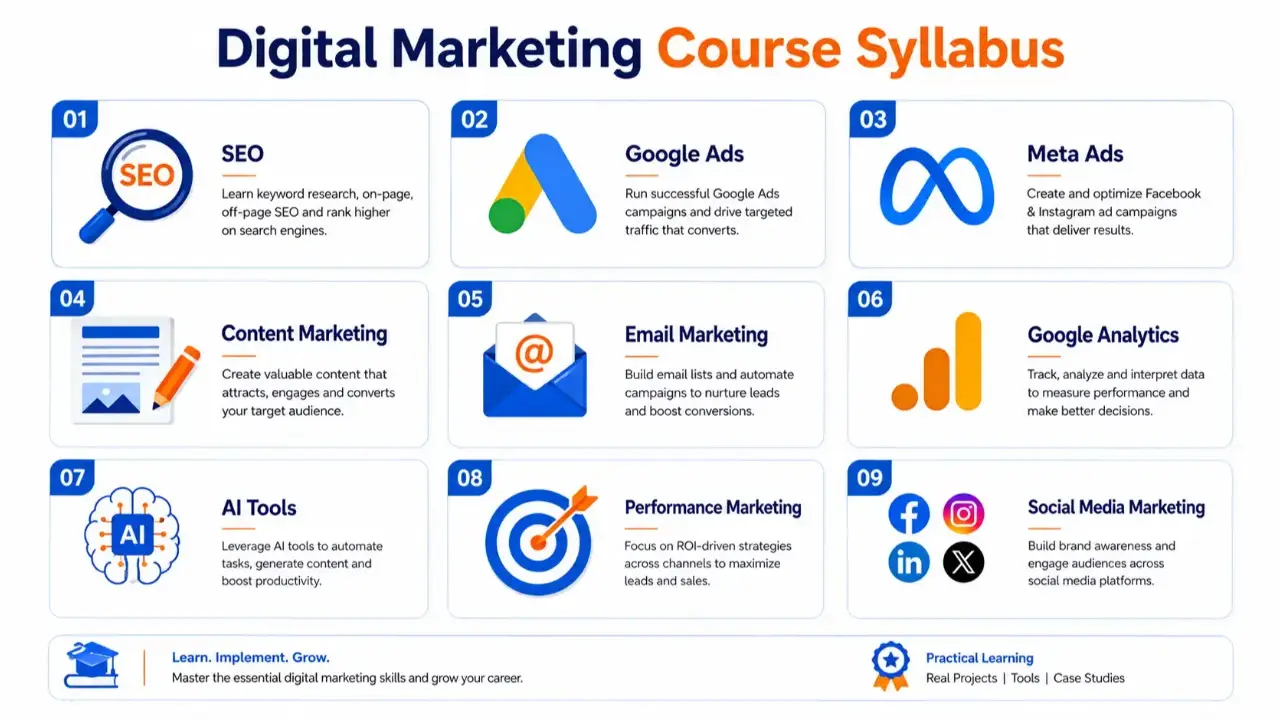
A complete digital marketing course should cover the fundamentals of strategy and analytics, then go deep on the core channels: SEO, Google Ads and paid search, paid social, email marketing, content, and web analytics with conversion tracking. Beyond the channels, it should teach how the pieces fit into a funnel, how to read data and decide what to change, and how to apply it all to a real business rather than a hypothetical one. The strongest sign of a good course is not the topic list but the outputs: does finishing it leave you with work you have actually done, such as a live campaign, an optimized page or a real analytics setup, rather than a certificate and a folder of notes? Use the checklist below to measure any course, ours included, against that standard.
Almost every course provider publishes a curriculum, and almost every one of them looks comprehensive at a glance. The problem is that a topic list tells you what a course mentions, not what it teaches you to do. This is a neutral standard you can hold any digital marketing course against, whether it is free, a subscription, a bootcamp or a university module. If a course you are considering skips several of these, that is worth knowing before you pay. For the wider decision of whether to buy at all, see our guide on whether a digital marketing course is worth the money.
The foundations every course should cover first
Before any channel, a good course grounds you in how digital marketing actually works as a system. Skipping this is the most common weakness in channel-specific and platform-run courses, which teach you to operate a tool without teaching you when or why to use it.
- Strategy and the marketing funnel. Awareness, consideration, conversion and retention, and which channels serve which stage. Without this, you learn tactics with no framework for choosing between them.
- Audience and positioning. Who you are trying to reach, what they search for, and how to talk to them. Every channel decision flows from this.
- Goals and metrics. The difference between a vanity metric and one that maps to revenue, and how to set a target you can actually measure against.
The core channels a complete course teaches
This is the body of any real curriculum. A course does not have to go equally deep on all of these, but it should cover them, and it should be honest about which it treats as fundamentals versus overviews.
Search engine optimization (SEO). How search works, keyword research, on-page optimization, local SEO for businesses with a physical presence, and the basics of technical SEO and links. For most small businesses this is the highest-return channel, so a course that rushes it is a warning sign. Our own breakdown of SEO for small business covers the ground a course should.
Google Ads and paid search. How the ad auction works, campaign structure, keyword match types, writing ads, and reading the numbers so you are optimizing for booked business rather than clicks. It should also cover Google Local Services Ads for service businesses, since that is where a lot of high-intent local demand now sits.
Paid social. Meta, and increasingly TikTok, covering targeting, creative, budgets and measurement. A good course is clear that paid social suits some businesses far better than others, rather than presenting it as universal.
Email marketing. List building, segmentation, automation and the basic legal rules, which in the US means CAN-SPAM and consent before texting. Email is consistently one of the highest-ROI channels and one of the most under-taught, so its depth is a good quality signal.
Content marketing. How to plan, produce and distribute content that earns attention and supports the other channels, rather than content for its own sake.
Web analytics and conversion tracking. GA4, setting up conversion tracking, and reading data to decide what to change. This is the connective tissue that makes every other channel measurable, and a course that treats it as an afterthought is teaching you to fly blind.
The part most courses skip: turning knowledge into decisions
Here is the difference between a course that makes you employable or effective and one that just makes you informed, and it is the single most useful thing to check for.
Plenty of courses teach you what each channel is. Far fewer teach you how to decide: which channel to start with given a specific budget, how to read a set of results and know what to change, how to diagnose why a campaign is underperforming, and when to stop doing something that is not working. That judgment is what separates someone who can operate a tool from someone who can run marketing, and it is precisely what a topic list cannot show you.
Look for courses built around decisions rather than definitions: scenarios, worked examples, "here is the data, what would you do" exercises. A course that ends every module with a real task you complete is teaching judgment. A course that ends every module with a multiple-choice quiz is teaching recall.
What separates a course for business owners from one for job seekers
The same topic list serves two different readers badly if it does not acknowledge the split, and a good course is clear about which it is for.
If you run a business, you need enough of each channel to make good decisions and to brief or check anyone you hire, applied directly to your own situation. You do not need certification-exam depth on platforms you will pay someone else to run. You need to know what good looks like. A course aimed at you should let you act on your own business as you go.
If you want a marketing job, you need deeper platform fluency, recognized certifications, and a portfolio of real work to show. The topic list is broader and the depth on specific platforms matters more. If that is you, our guides on how many certifications you actually need and which certificate is most respected go deeper on the credential side.
A course that does not say which of these two readers it is built for is usually built for neither.
Currency, support and honesty about scope
Three things sit outside the curriculum but tell you as much about a course as the syllabus does.
- Recent updates. Digital marketing changes fast. Content referencing tools that no longer exist, such as Universal Analytics rather than GA4, or last updated more than 18 months ago, is a red flag. A good course states when it was last revised.
- Some form of support or feedback, whether that is instructor access, a community, or reviewed assignments. Pure video with no feedback loop makes it much harder to know whether you are doing it right.
- Honesty about what it does not cover. A course that claims to make you an expert in every channel in a weekend is lying. One that says plainly "this makes you competent across the fundamentals, and here is what it deliberately leaves out" is more trustworthy and usually better.
That last point is also how to read this checklist against a specific provider. Any course, ours included, will be stronger on some of these than others. To pressure-test one you are considering, run it through our guide on how to spot a course scam, which turns the same honesty test into a 20-minute due-diligence process.
How 20 Minute Marketing measures against this standard
Since we are handing you a checklist to judge courses by, it is only fair to say where ours lands on it, including where it does not fit.
20 Minute Marketing is built for the first reader above, the business owner rather than the job seeker. It covers the foundations and all six core channels, it is structured around a real task at the end of each lesson so you are acting on your own business as you go, and it is written for the US, AU and NZ markets rather than adapted from one. It is deliberately paced, one short lesson at a time, because implementation, not information, is where most people stall.
What it is not: it is not an accredited qualification, it does not offer live one-to-one instruction, and it is not designed to make you certification-exam-ready for a paid-media specialist role. If you need a recognized credential for a job application, a university program or a platform certification is the better fit, and we say so throughout. That is the honest placement, and the checklist above is the one we would want you to hold us to.
The one-page checklist
Print this, or keep it open in a tab, and run any course you are considering through it:
- Does it teach strategy and the funnel before individual tactics?
- Does it cover all six core channels: SEO, paid search, paid social, email, content and analytics?
- Does it teach decisions and diagnosis, not just definitions?
- Will I finish with real outputs I have actually built?
- Is it clear whether it is for business owners or job seekers?
- Was it updated recently, and does it say when?
- Is there any support or feedback, or is it video-only?
- Is it honest about what it does not cover?
A course does not need a perfect score. But if it misses several, especially the outputs question, you now know what you are trading away before you pay for it.
Frequently asked questions
What topics should a beginner digital marketing course cover?
Strategy and the funnel first, then the core channels: SEO, Google Ads and paid search, paid social, email, content, and web analytics with conversion tracking. A beginner course should prioritize breadth and decision-making over deep specialization in any single platform, so you can tell which channels are worth your time before you commit to one.
How long should a digital marketing course be?
Length matters less than structure and completion. A short course you finish and apply beats a comprehensive one you abandon halfway. What matters is whether the format fits your actual life, since the most common reason people fail to finish is that the course demanded more time than they had.
Should a course include certifications?
It depends on your goal. If you want a marketing job, recognized certifications help, though a portfolio of real work matters more. If you run a business, certifications are close to irrelevant, and applied skill is everything. A course that leads with its certificate rather than its outcomes is optimizing for the wrong thing.
Do I need a course that covers every channel?
To start, yes, at least at an overview level, because you cannot choose where to focus until you understand your options. Once you know which channels fit your business or career, going deep on two or three beats staying shallow across all of them.
What is the most overlooked topic in digital marketing courses?
Web analytics and conversion tracking, closely followed by the judgment layer of reading data and deciding what to change. Many courses teach you to run channels but not to measure them or act on what the numbers say, which is the part that actually determines whether your marketing works.
See how we measure up
Foundations, all six core channels, and a real task at the end of every lesson. Run us through the checklist above and see for yourself.
See the coursesLearn digital marketing in 20 minutes a day
Self-paced courses from someone who runs digital for two national brands. Build skills you can show an employer or a client.